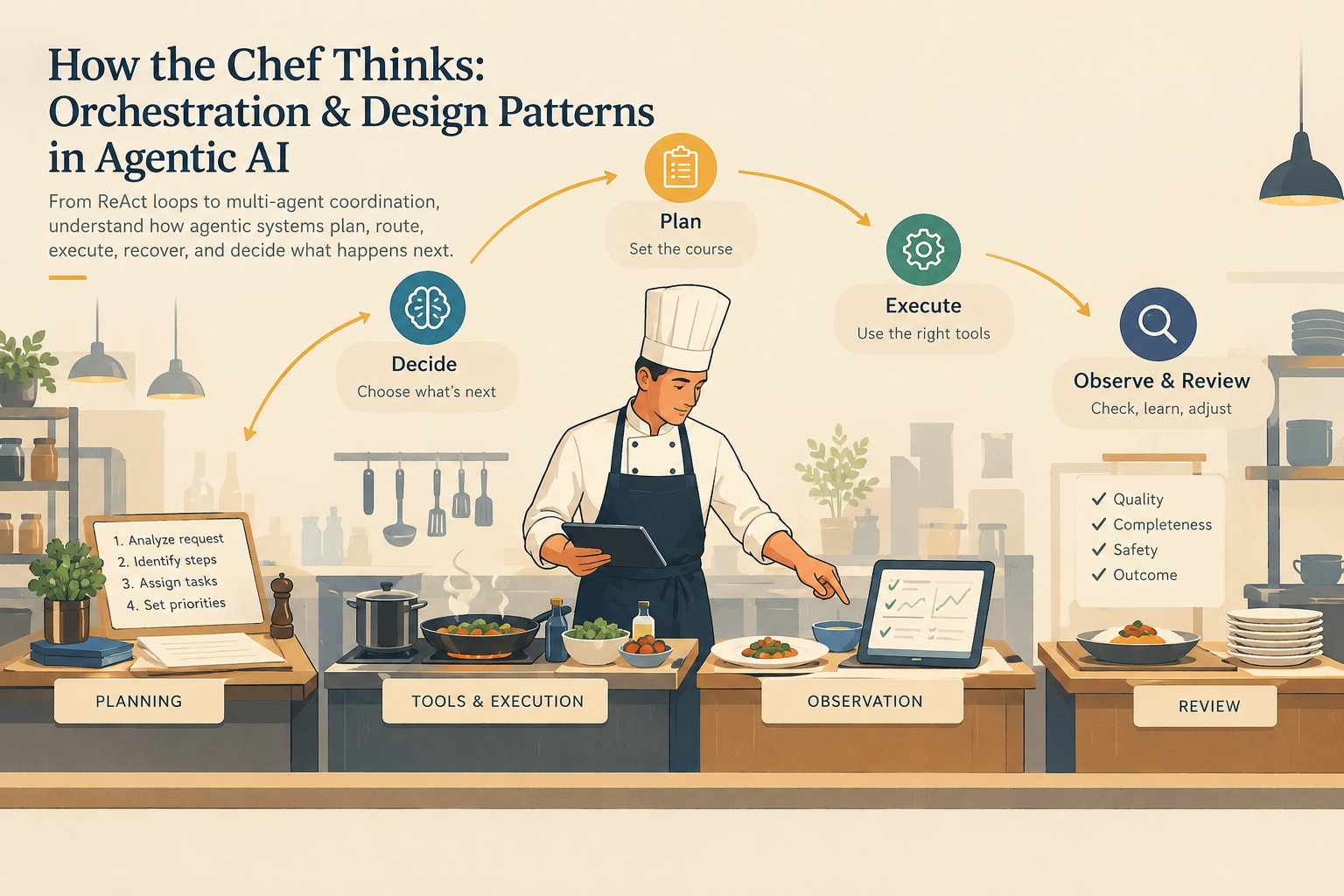
How the Chef Thinks: Orchestration & Design Patterns in Agentic AI
The Culinary Architecture of Agentic AI — Part 4

We’ve all seen it: someone drops a massive, incredibly powerful AI model into a workflow just to do a simple task—like sorting a spreadsheet or checking a form for errors. It works, sure. But it’s the tech equivalent of hiring a rocket ship just to drive down the street for groceries. It’s slow, incredibly expensive at scale, and honestly, a bit overkill. If we want to build real, reliable systems, we need to move past the hype. Instead of using one giant AI model for everything, the secret is building intelligent cascades—a team of different-sized systems working together. Let’s break down exactly how this works, completely in plain English.

Many people believe AI Agents and Agentic AI are two competing technologies. They are not. They represent different maturity levels of the same evolutionary path. The Core Difference AI Agent: The ba

The year is 2026. The hum of the data center has been replaced by the silent, rapid-fire processing of AI agents. Imagine you are sitting in the cockpit of a high-tech jet. For years, you went to "Fli

By Bhanuprakash Reddy, Pindikuru Harshil Kumar, Bhargava G Introduction Agriculture plays a critical role in global food security, yet plant diseases remain a major challenge, causing substantial crop losses. Traditional disease detection relies on m...

Minikube is a great tool for running a single-node Kubernetes cluster locally on your Ubuntu machine for development and testing purposes. This guide will walk you through the installation process step-by-step. Before you begin: Make sure you are us...

Learning CSS (Cascading Style Sheets) thoroughly involves understanding various concepts, properties, and techniques. Here's a comprehensive road map to help you learn CSS from beginner to advanced levels. Remember that practice and hands-on coding a...