The Culinary Architecture of Agentic AI: A Blueprint for Autonomous Systems
What does it actually take to build an autonomous AI system? An LLM is only the beginning. Just as a biryani is far more than rice and meat, an agent is far more than a model wrapped inside a loop.
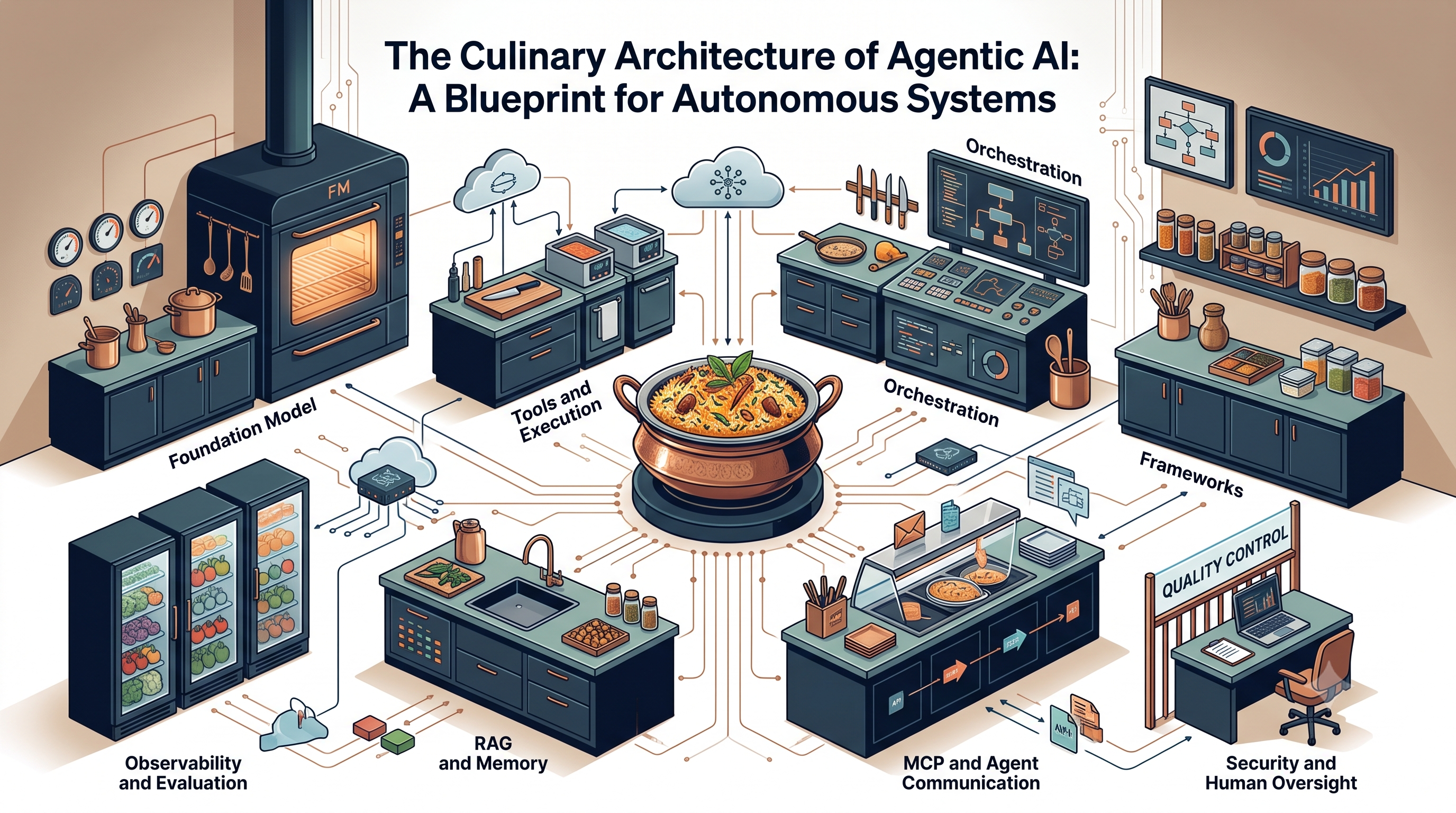
The Big Picture: Welcome to the AI Kitchen
The world of Agentic AI can feel overwhelming.
There are foundation models, embeddings, vector databases, RAG, tools, memory, orchestration frameworks, sandboxes, MCP, A2A, guardrails, human approval, observability, evaluation...
And then there are dozens of frameworks and platforms competing for attention.
It is easy to look at all of this and wonder:
"How does all of this actually fit together?"
One way to make the architecture easier to understand is to stop looking at the individual technologies first.
Instead, think about building a biryani.
The goal isn't simply to collect rice, meat, spices, and vegetables.
The real challenge is knowing:
which ingredients are needed,
how much of each to use,
when to introduce them,
how they interact,
how the cooking process should be controlled,
how to taste and correct the dish,
and ultimately, how to serve it safely.
Agentic AI follows a surprisingly similar architecture.
The Ingredients of an AI Agent
Before diving into the deeper architecture, let's establish the basic mapping.
| AI Concept | Culinary Analogy | What it represents |
|---|---|---|
| Foundation Model | 🍚 Rice | The core reasoning substrate |
| Tokens | 🌾 Individual grains | The smallest units processed by the model |
| Context Window | 🍲 Cooking pot | How much information can be processed at once |
| Inference | 🔥 Cooking | The actual computation performed by the model |
| Embeddings | 🧂 Ground spices | Converting information into a mathematical representation |
| Semantic Search | 👅 Tasting for flavor | Finding information based on meaning rather than exact words |
| RAG | 🧺 Checking the pantry | Bringing external knowledge into the reasoning process |
| Tools | 🔪 Kitchen utensils | Capabilities that allow the agent to take action |
| MCP | 🔌 Standardized outlets | A common interface for connecting agents to tools and data |
| Memory | 🥣 Marination | Preserving useful context over time |
| Orchestration | 👨🍳 Cooking technique | Controlling how reasoning and actions happen |
| Security & Guardrails | 🥛 Raita & 🌶️ Salan | Balancing autonomous power with safety |
| Observability | 👅 Taste testing | Understanding whether the system actually performed well |
This gives us the basic map.
Now let's build the kitchen.
What Makes Agentic AI Different?
The preparation of an authentic biryani isn't simply the act of throwing ingredients into a pot.
It is an orchestrated process of layering, timing, balancing, and transformation.
A chef decides:
which rice to use,
which spices belong in the dish,
what the primary ingredient should be,
how the ingredients should interact,
how long everything should cook,
and how the final dish should be evaluated.
Agentic AI works in much the same way.
A modern autonomous system is no longer simply:
User → LLM → Answer
Instead, it increasingly looks like:
                 ┌───────────────┐
                 │    User       │
                 └───────┬───────┘
                         │
                         ▼
                 ┌───────────────┐
                 │ Orchestrator  │
                 └───────┬───────┘
                         │
              ┌──────────┼──────────┐
              ▼          ▼          ▼
          Reasoning    Memory     Tools
              │          │          │
              └──────────┼──────────┘
                         ▼
                    Observation
                         │
                         ▼
                     Evaluation
                         │
                    ┌────┴────┐
                    │         │
                  Retry      Done
The agent perceives information, reasons about it, decides what should happen next, interacts with external systems, observes the result, and potentially repeats the process.
That is the fundamental difference between a model and an agentic system.
The Eight Layers of the Agentic AI Kitchen
The rest of this series will break the architecture into eight major layers:
🍚 Foundation Models — The Rice
🍗 Tools & Action Spaces — The Main Ingredient
👨🍳 Orchestration & Design Patterns — The Cooking Technique
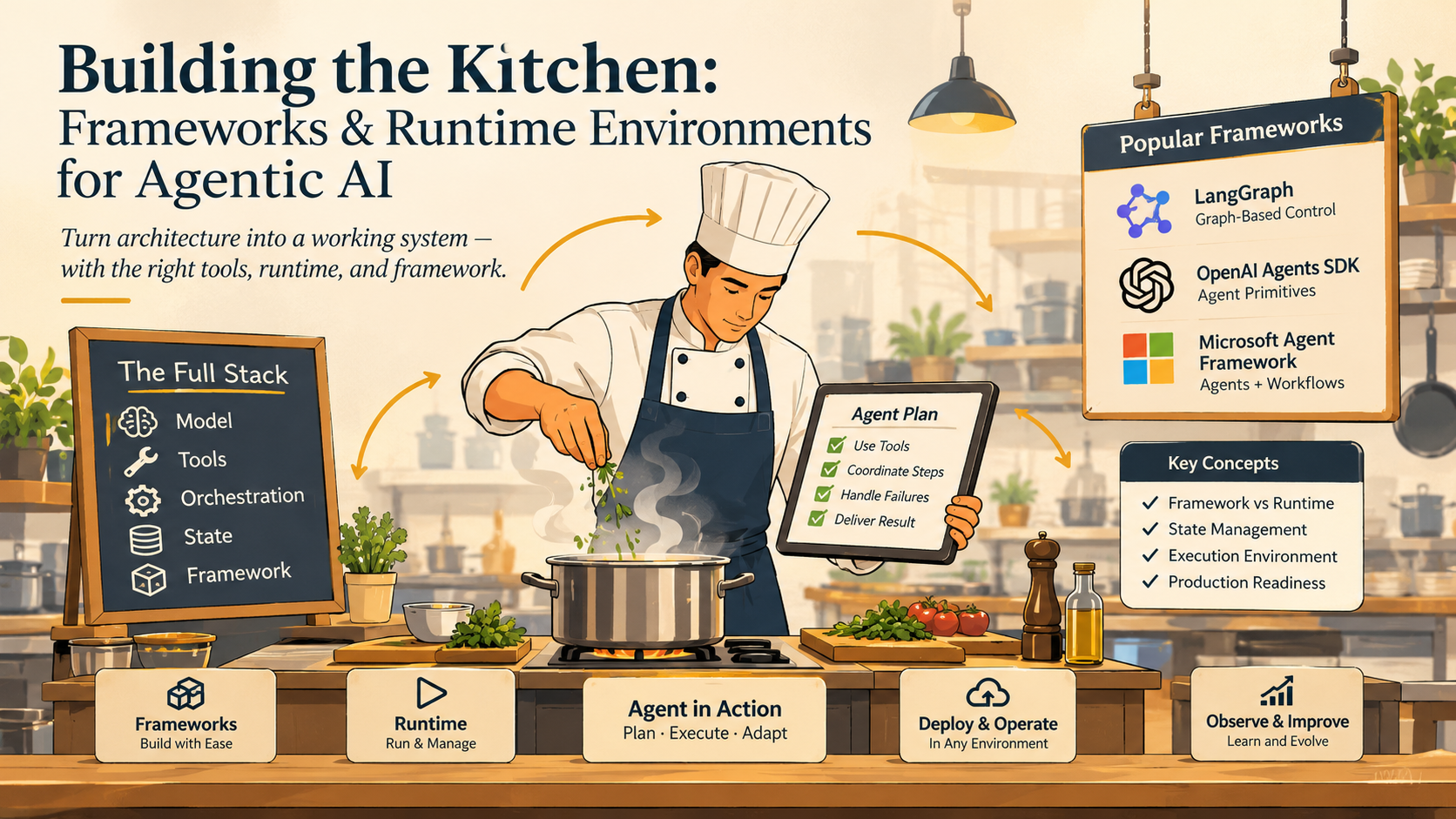
🍲 Production Frameworks — The Vessel
🌶️ RAG, Embeddings & Memory — The Spices & Marination
🍽️ Integration Protocols — The Waitstaff & Cutlery
🥛 Security, Safety & HITL — The Raita & Salan
👅 Observability & Evaluation — The Taste Test
Let's explore each layer.
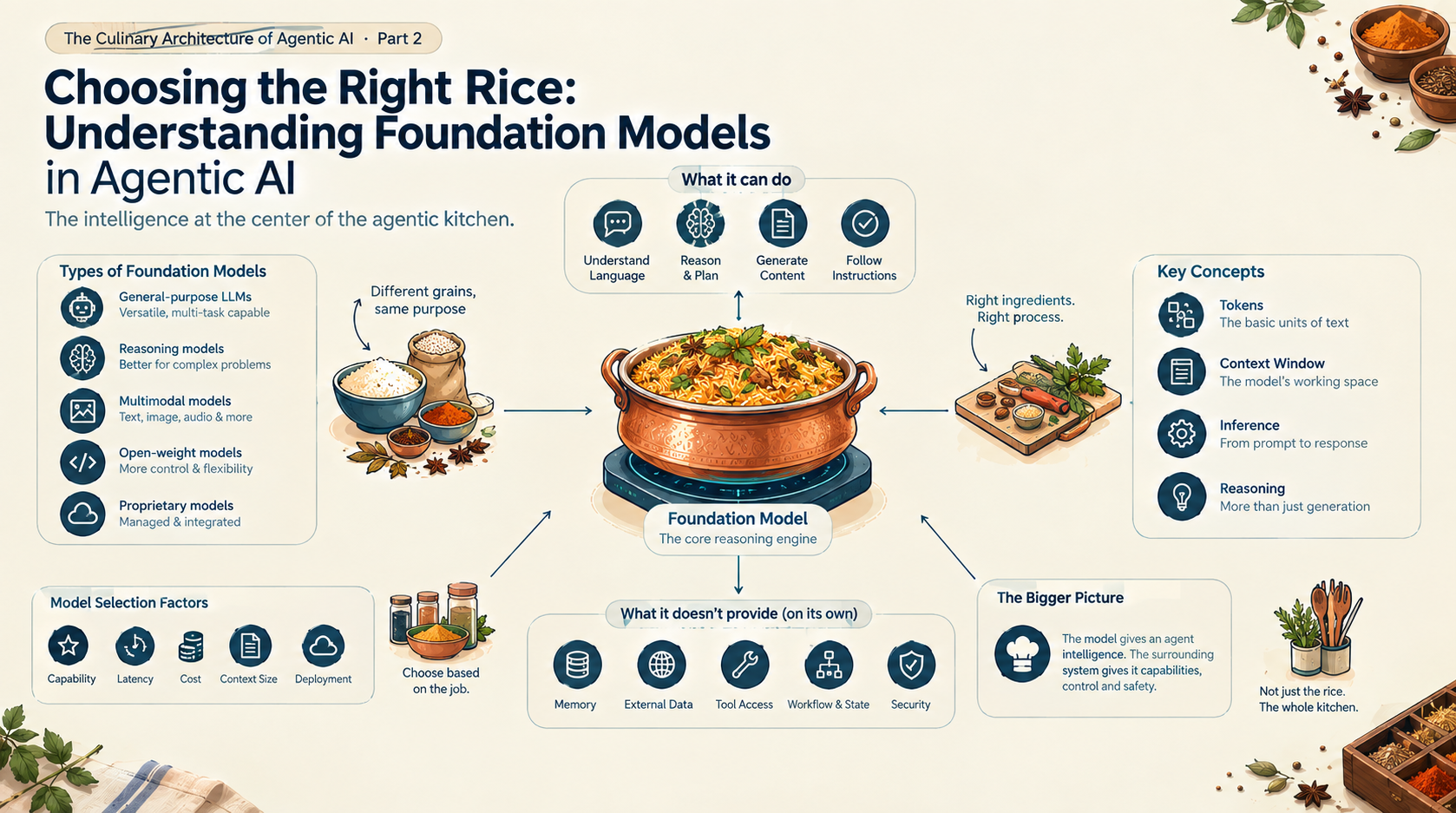
🍚 Layer 1: Foundation Models — The Rice
Every biryani needs a foundation.
Rice provides the underlying structure of the dish. Different varieties produce different textures, absorb flavors differently, and behave differently during cooking.
The same principle applies to foundation models.
The LLM is the reasoning substrate of the agent.
It processes inputs, interprets information, generates plans, and produces outputs.
But there is an important distinction:
An LLM is not an agent.
Rice isn't biryani.
Likewise, a language model isn't an autonomous system by itself.
The model becomes part of an agent when it is combined with mechanisms for:
planning,
memory,
tool usage,
execution,
observation,
feedback,
and control.
Choosing the Right Model
Not every task requires the largest or most capable model.
A sophisticated agentic architecture may route different tasks to different models depending on:
reasoning complexity,
latency requirements,
cost,
context size,
reliability,
and workload volume.
Think of it as choosing the appropriate rice for the dish.
You wouldn't necessarily use the same rice for every biryani.
Similarly, you shouldn't necessarily use the same model for every operation in an agentic system.
From Cost Per Token to Cost Per Outcome
One of the most important economic considerations in agentic systems is that a single user request may trigger many model calls.
An agent may:
Plan
  ↓
Call Tool
  ↓
Read Result
  ↓
Reason Again
  ↓
Call Another Tool
  ↓
Validate
  ↓
Retry
So optimizing only the cost of an individual model invocation can be misleading.
The more meaningful question becomes:
How much does it cost to successfully complete the task?
A cheaper model that repeatedly fails may ultimately cost more than a stronger model that completes the task correctly on the first attempt.
The Context Window Economy
Context is another major resource.
Every additional instruction, tool schema, retrieved document, memory fragment, and previous interaction increases the amount of information the model must process.
This is why techniques such as:
semantic caching,
prompt caching,
context management,
become increasingly important as agentic workflows grow.
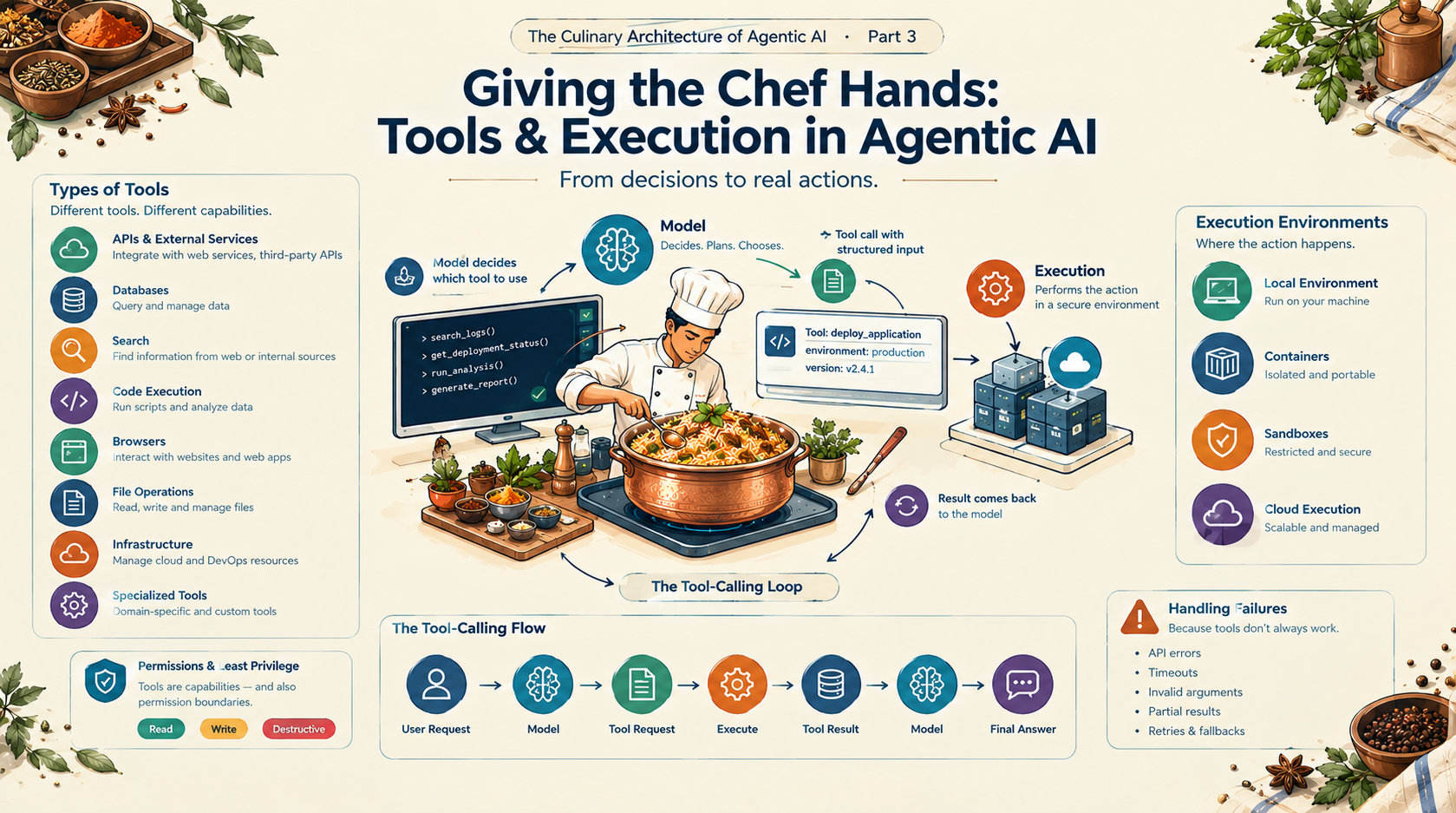
🍗 Layer 2: Tools & Action Spaces — The Main Ingredient
Rice alone doesn't define the biryani.
The main ingredient gives the dish much of its identity.
Chicken.
Paneer.
Egg.
Vegetables.
Likewise, tools define what an AI agent can actually do.
An agent with access to:
Python
GitHub
Terminal
File System
can become a powerful coding agent.
An agent with:
CRM
Email
Ticketing System
Customer Database
can become a customer-support or customer-success agent.
The reasoning model may remain similar.
The action space changes the agent's capabilities.
Giving Agents Hands Creates Risk
The moment an agent can take real actions, the security model changes dramatically.
Reading information is one thing.
Writing to a database is another.
Executing arbitrary code is another level entirely.
You wouldn't cook biryani directly on a wooden table.
You need a controlled cooking environment.
Agentic systems need the same principle.
Code Execution Sandboxes
Code execution sandboxes provide isolated environments where an agent can execute generated code without directly exposing the host system.
The basic loop becomes:
Agent
  ↓
Generate Code
  ↓
Sandbox
  ↓
Execute
  ↓
Return Output / Error
  ↓
Agent Reviews Result
  ↓
Fix / Retry
This turns code execution into a controlled feedback loop.
Platforms such as E2B, Blaxel, and Modal represent different approaches to providing isolated execution environments, with trade-offs around isolation, persistence, startup latency, and compute requirements.
The important architectural idea is not the vendor.
It is the boundary:
Give the agent a workspace to act in — without giving it unrestricted access to the kitchen.
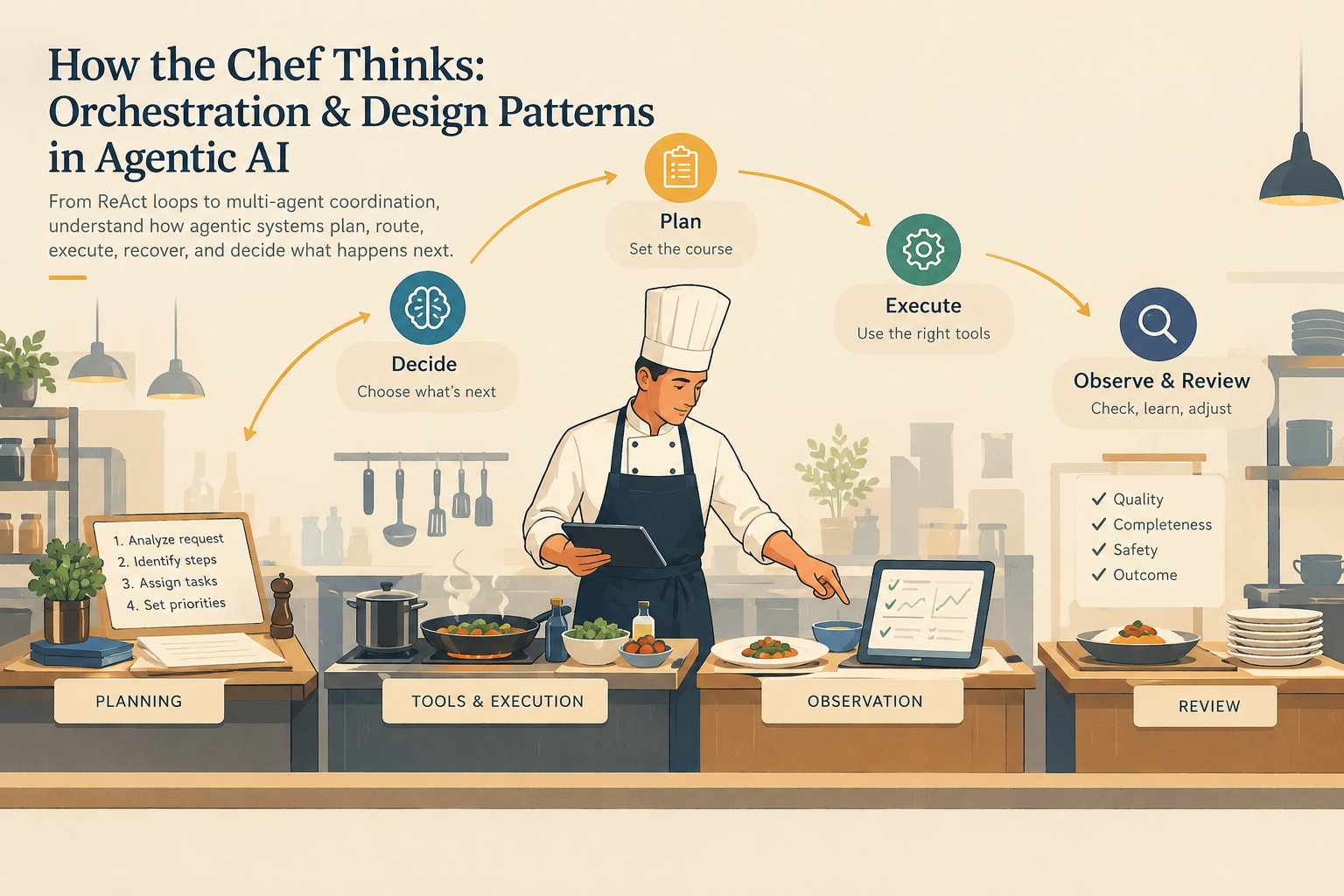
👨🍳 Layer 3: Orchestration & Design Patterns — The Cooking Technique
You have the ingredients.
Now comes the cooking technique.
A chef can prepare biryani using different methods depending on the desired result.
Likewise, an agent can be orchestrated using different reasoning and execution patterns.
ReAct — Reasoning + Acting
The ReAct pattern alternates between reasoning and action.
Reason
  ↓
Act
  ↓
Observe
  ↓
Reason
  ↓
Act
  ↓
Observe
This is powerful for dynamic problems because the agent can adapt based on what happens.
But unrestricted loops can also become problematic.
An agent may:
repeatedly call a failing tool,
wander through unnecessary reasoning,
consume excessive tokens,
or fail to recognize when it should stop.
Plan → Execute
A more structured approach separates planning from execution.
User Request
     ↓
   Planner
     ↓
Execution Plan
     ↓
   Executor
     ↓
Tool Calls
     ↓
   Results
The planner determines what should happen.
The executor carries out the plan.
This can introduce greater determinism into workflows where uncontrolled reasoning is undesirable.
It also creates a natural point where human approval can be introduced before execution.
Multi-Agent Systems
Some problems are simply too broad for one agent.
Instead of building one enormous agent that tries to do everything, the workload can be divided among specialized agents.
For example:
             Supervisor
                 │
       ┌─────────┼─────────┐
       ▼         ▼         ▼
   Research    Coding     Review
     Agent      Agent      Agent
Each agent specializes in a particular responsibility.
More sophisticated reasoning approaches such as Tree of Thoughts and Graph of Thoughts explore multiple reasoning paths before selecting or combining useful results.
The trade-off is straightforward:
More reasoning paths can increase capability — but also increase latency and token consumption.
From Prompt Engineering to Prompt Compilation
As agentic systems become more complex, manually tweaking prompts across an entire system becomes increasingly difficult to maintain.
Frameworks such as DSPy approach this problem differently.
Instead of treating prompts as isolated strings, developers can define the desired inputs, outputs, and evaluation criteria and allow the system to optimize the underlying prompting strategy.
The shift is from:
"Write the perfect prompt."
to:
"Define the behavior and optimize the program."
🍲 Layer 4: Production Frameworks — The Vessel
A cooking technique still needs a vessel.
In software, that vessel is the agent framework and runtime.
These frameworks provide abstractions for:
state,
execution,
memory,
workflow transitions,
persistence,
and event handling.
LangGraph
LangGraph models agent workflows as graphs.
A workflow might look like:
START
  ↓
Analyze
  ↓
Plan
  ↓
Tool Call
  ↓
Validate
  ├── Success → END
  └── Failure → Retry
Because the workflow is explicitly represented as a graph, each execution can be inspected as a path through the system.
This makes graph-based orchestration particularly useful for stateful and cyclical agent workflows.
CrewAI
CrewAI takes a role-based multi-agent approach.
Instead of thinking primarily in terms of graph nodes, developers can define agents around:
roles,
goals,
tools,
responsibilities,
and collaboration patterns.
It is particularly intuitive for workflows that naturally resemble a team of specialists.
LlamaIndex
LlamaIndex provides abstractions particularly useful for data-centric and retrieval-heavy applications.
It can act as the bridge between agents and the information they need to reason over.
n8n
For teams that don't want to build every orchestration component from scratch, visual workflow platforms such as n8n provide another approach.
Instead of writing the entire system programmatically, developers can visually connect:
Trigger
  ↓
LLM
  ↓
Tool
  ↓
Condition
  ↓
Another Tool
  ↓
Output
Different vessels.
Different cooking techniques.
Same fundamental objective:
Turn individual ingredients into a functioning autonomous system.
🌶️ Layer 5: Agentic RAG, Embeddings & Memory — The Spices & Marination
A biryani without spices is technically food.
But it isn't the same dish.
Spices provide context, depth, and character.
In agentic systems, that contextual depth comes from retrieval, embeddings, and memory.
Traditional RAG
A traditional RAG pipeline usually looks like:
User Query
    ↓
Embedding
    ↓
Vector Search
    ↓
Retrieve Documents
    ↓
Add Context
    ↓
LLM
    ↓
Answer
This works well for straightforward information retrieval.
But complex questions may require more than one search.
Agentic RAG
Agentic RAG turns retrieval into an active reasoning process.
Instead of simply asking:
"Which documents are similar to this query?"
the agent can ask:
"What information do I need, where can I find it, and is the information I retrieved actually sufficient?"
Three important responsibilities emerge.
1. The Router
Determines where to search.
Factual question → Vector Database
Real-time question → Web Search
Analytical question → SQL
2. The Planner
Breaks complex questions into smaller retrieval tasks.
For example:
Compare Phone A vs Phone B
        ↓
Search Phone A
        ↓
Extract Battery Data
        ↓
Search Phone B
        ↓
Extract Battery Data
        ↓
Compare
3. The Critic
Evaluates whether the retrieved information is actually sufficient.
If the evidence is poor:
Retrieve
  ↓
Evaluate
  ↓
Insufficient?
  ↓
Reformulate Query
  ↓
Retrieve Again
This feedback loop is what makes the retrieval process agentic.
🧺 The Pantry: Vector Databases
Every kitchen needs a pantry.
For AI agents, the pantry is often a vector database.
Different indexing strategies make different trade-offs between:
retrieval latency,
recall,
memory consumption,
scale,
and infrastructure cost.
| Index | Core Idea | Typical Trade-off |
|---|---|---|
| HNSW | Graph-based in-memory search | Extremely fast, but memory intensive |
| DiskANN | Disk-oriented graph search | Large-scale retrieval with lower RAM pressure |
| IVF-PQ | Clustered search + vector compression | Efficient memory usage with potential recall trade-offs |
The right choice depends on the workload.
🥣 Memory: The Marination Layer
RAG provides external knowledge.
Memory provides continuity.
An agent may require:
Short-Term Memory
Context about the current task.
For example:
"I already tried this tool and it failed."
Long-Term Memory
Information that persists between sessions.
For example:
"This user prefers information formatted as tables."
Together, retrieval and memory allow an agent to become more context-aware over time.
🍽️ Layer 6: Integration Protocols — The Waitstaff & Cutlery
A large kitchen isn't useful if every station speaks a different language.
Historically, AI systems relied heavily on custom integrations.
Every tool required its own connector.
Every platform had its own interface.
This doesn't scale particularly well.
That is where standardized protocols become important.
MCP — The Universal Kitchen Outlet
The Model Context Protocol (MCP) provides a standardized interface through which AI applications can connect with external tools and data sources.
Think of it as:
USB-C for AI systems.
Instead of creating a completely custom integration for every AI application and every tool, MCP establishes a common interaction model.
MCP servers can expose capabilities such as:
📦 Resources
Information the agent can read.
🔧 Tools
Functions the agent can execute.
📝 Prompts
Reusable workflow or instruction templates.
The larger idea is simple:
Build the connector once. Let compatible AI systems discover and use it.
A2A — Agents Talking to Agents
MCP primarily addresses:
Agent → Tool
But large autonomous systems also need:
Agent → Agent
This is where Agent2Agent (A2A) comes into the picture.
Imagine an enterprise workflow with:
Triage Agent
      ↓
Billing Agent
      ↓
Fulfillment Agent
Each agent specializes in a particular responsibility.
A2A provides a standardized way for independent agents to discover capabilities and collaborate.
Important concepts include:
Agent Cards — describing an agent's identity and capabilities
Task Lifecycles — tracking long-running operations
Opaque Collaboration — allowing agents to cooperate without exposing internal prompts or proprietary logic
Together:
MCP
Agent → Tools / Data

A2A
Agent → Agent
These protocols represent two different directions of communication in an agentic ecosystem.
🥛 Layer 7: Security, Safety & Human-in-the-Loop — The Raita & Salan
Biryani is powerful.
It can also be overwhelming without balance.
That is why raita and salan exist.
Agentic AI needs the same principle.
The more powerful the agent becomes, the more important its boundaries become.
Prompt Injection
A chatbot that encounters malicious instructions may simply generate a bad response.
An autonomous agent is different.
If that agent has:
database access,
code execution,
credentials,
file access,
cloud permissions,
then malicious instructions can potentially influence real-world actions.
The attack surface therefore changes dramatically when an LLM gains tools.
Guardrails
Security mechanisms can be placed around the model and the tools to:
validate inputs,
detect malicious intent,
restrict actions,
enforce policies,
protect sensitive information,
and control execution.
Tools and MCP servers should also operate under principles such as:
least privilege,
network isolation,
controlled egress,
credential validation,
and explicit permission boundaries.
The objective isn't to eliminate autonomy.
It is to make autonomy bounded.
Human-in-the-Loop
The safest autonomous system isn't necessarily the one with zero humans.
Sometimes the correct architecture is:
Let the machine move fast — until the consequences become significant.
This can be implemented through control gates.
Rule-Based Gates
Certain operations always require human approval.
For example:
Financial Transaction
        ↓
Human Approval
        ↓
Execute
or:
Production Deployment
        ↓
Human Approval
        ↓
Deploy
Risk-Based Gates
The agent evaluates the potential impact of an action.
If the risk crosses a defined threshold:
Agent Decision
      ↓
Risk Assessment
      ↓
High Risk?
   ↙       ↘
 YES        NO
  ↓          ↓
Human      Execute
Approval
This creates a useful principle:
Low-risk actions can move at machine speed. High-impact actions remain under human control.
👅 Layer 8: Observability & Evaluation - The Taste Test
A chef doesn't serve a dish without tasting it.
Likewise, an agent shouldn't be considered reliable simply because it generated an answer.
Traditional software testing often assumes:
Input → Deterministic Output
Agentic systems are different.
They can contain:
branching workflows,
multiple model calls,
tool interactions,
retries,
stochastic outputs,
and dynamic decisions.
Therefore, the final answer isn't enough.
We need to evaluate the entire trajectory.
The Compounding Error Problem
Imagine three sequential agents.
If each stage succeeds 90% of the time:
Agent 1 → 90%
Agent 2 → 90%
Agent 3 → 90%
The probability of all three succeeding is approximately:
0.9 × 0.9 × 0.9 = 72.9%
A small weakness at each stage can therefore become a significant reliability problem across the entire workflow.
This is why evaluating the complete agentic trajectory matters.
Evaluation Frameworks
Several tools and benchmarks can help evaluate different parts of an agentic system.
DeepEval
A Python-oriented evaluation framework that can integrate into testing and deployment workflows.
It can evaluate dimensions such as:
hallucination,
bias,
tool correctness,
and other quality metrics.
RAGAS
Focused heavily on retrieval-augmented systems.
It can evaluate dimensions such as:
context precision,
context recall,
faithfulness.
SWE-bench & GAIA
Benchmarks that can be used to evaluate broader capabilities such as:
coding,
tool usage,
autonomy,
and multi-step reasoning.
Observability
When something goes wrong in production, the question isn't simply:
"What answer did the model produce?"
The more important question is:
"How did the system arrive here?"
Observability platforms such as LangSmith, Langfuse, and Braintrust can capture information about agent execution, including:
model calls,
tool calls,
latency,
retrieval operations,
token consumption,
errors,
and workflow traces.
This transforms an agent from a mysterious black box into something that engineers can actually inspect.
Observability Meets AI FinOps
There is another important connection.
Agentic AI is also a cost-management problem.
A single user request might trigger:
1 Planning Call
+
3 Retrieval Calls
+
2 Tool Calls
+
4 Reasoning Calls
+
2 Validation Calls
Suddenly, one request isn't one model call.
It is an entire computational workflow.
Observability therefore becomes the foundation for AI FinOps.
Teams can identify:
unnecessary retries,
inefficient prompts,
expensive reasoning paths,
excessive context,
noisy agents,
and opportunities for model routing.
The goal becomes:
Use the expensive reasoning where it creates value, and use cheaper mechanisms everywhere else.
Conclusion: Serve the Complete Architecture
Agentic AI has moved far beyond:
while True:
    ask_llm()
Reliable autonomous systems require architecture.
They require layers.
They require boundaries.
And most importantly, they require understanding how those layers interact.
A modern agentic system can be viewed as a complete culinary architecture:
| Layer | 🍛 Ingredient | Purpose |
|---|---|---|
| 1 | 🍚 Foundation Models | Reasoning substrate |
| 2 | 🍗 Tools & Action Spaces | Ability to act |
| 3 | 👨🍳 Orchestration | Control the reasoning workflow |
| 4 | 🍲 Frameworks | Runtime and state management |
| 5 | 🌶️ RAG & Memory | Context and knowledge |
| 6 | 🍽️ MCP & A2A | Connectivity and collaboration |
| 7 | 🥛 Security & HITL | Boundaries and governance |
| 8 | 👅 Observability & Evaluation | Reliability and feedback |
And just like biryani, the individual ingredients aren't the entire story.
The real engineering challenge lies in how they are combined.
A powerful model without tools is limited.
Tools without orchestration can become chaotic.
Orchestration without memory becomes forgetful.
Memory without retrieval can become stale.
Autonomy without guardrails becomes dangerous.
And an agent without observability becomes almost impossible to operate reliably.
The Blueprint for the Series
This article is the map.
The next articles will zoom into each layer individually.
We'll move from:
🍛 THE COMPLETE DISH
↓
🍚 THE RICE
↓
🍗 THE MAIN INGREDIENT
↓
👨🍳 THE COOKING TECHNIQUE
↓
🍲 THE VESSEL
↓
🌶️ THE SPICES & MARINATION
↓
🍽️ THE KITCHEN COMMUNICATION
↓
🥛 THE SAFETY & BALANCE
↓
👅 THE TASTE TEST
Each layer deserves its own deep dive.
Not just:
"What is it?"
but:
Why does it exist? What problem does it solve? What are the architectural choices? What are the trade-offs? How does it interact with the other layers? And when should an engineer actually use it?
That is where the real architecture begins.
The Kitchen Is Open
The ingredients are available.
The tools are becoming standardized.
The frameworks are evolving rapidly.
But assembling a collection of AI technologies does not automatically create an autonomous system.
The architecture is the recipe.
The components are the ingredients.
The engineer is the chef.
And the quality of the final dish depends not on any single ingredient—
but on how intelligently the entire kitchen is designed.
About the author
- I’m an engineer who enjoys turning messy engineering problems into simple, practical solutions. My work sits across AI automation, DevOps, SRE, cloud infrastructure, and developer experience. I like understanding why something is painful, finding ways to make it better, and building tools or workflows that reduce repetitive work and improve how developers operate. I write about the problems I encounter, the things I build, what I learn, and the ideas shaping modern engineering - from AI-assisted development and agentic systems to cloud automation, reliability, and developer tooling. I’m especially interested in the space where engineering, automation, and people meet - building useful technology and communicating it clearly.
Comments
Join the discussionHi and congratulations on this article. It covers many aspects of Agentic AI and I think I will have to read it a few more times to fully understand it.
I still haven’t managed to get rid of my doubts around prompt injection. Putting that aside, I also still need to understand how the cost of using these systems will actually be structured. Does it still make sense to talk about cost per token, or should we start talking about cost per outcome? And even if we accept that, should we then separate the cost between successful outcomes and retry cost?
Thanks again for the article, I’ll definitely read it again more carefully over the next few days!
Thank you for reading and for sharing these thoughtful questions
Prompt injection is definitely an important challenge, especially when agents interact with external content and tools. It highlights why we need to think beyond the model itself and consider trust boundaries, permissions, and validation.
On cost, I think cost per token still matters, but it doesn't tell the whole story. For agentic systems, cost per successful outcome can provide a more practical perspective, while tracking failed attempts and retry costs separately helps us understand where resources are being spent.
I've started publishing the continuation blogs, expanding on the individual layers of agentic AI one by one. I hope they help build a clearer picture of how these systems work and the challenges involved.
Really appreciate you taking the time to read and think deeply about the article!
The Culinary Architecture of Agentic AI
A layered guide to understanding how modern agentic AI systems are built—from foundation models and tools to orchestration, RAG, memory, agent communication, security, and observability. Using a culinary architecture metaphor, this series breaks down the components that turn an LLM into a reliable autonomous system.