🚀 Beyond the Hype: Building Smart AI Tiers (And How to Stay Indispensable)
We’ve all seen it: someone drops a massive, incredibly powerful AI model into a workflow just to do a simple task—like sorting a spreadsheet or checking a form for errors. It works, sure. But it’s the tech equivalent of hiring a rocket ship just to drive down the street for groceries. It’s slow, incredibly expensive at scale, and honestly, a bit overkill. If we want to build real, reliable systems, we need to move past the hype. Instead of using one giant AI model for everything, the secret is building intelligent cascades—a team of different-sized systems working together. Let’s break down exactly how this works, completely in plain English.

📊 The 5 Rules for Choosing the Right Tool
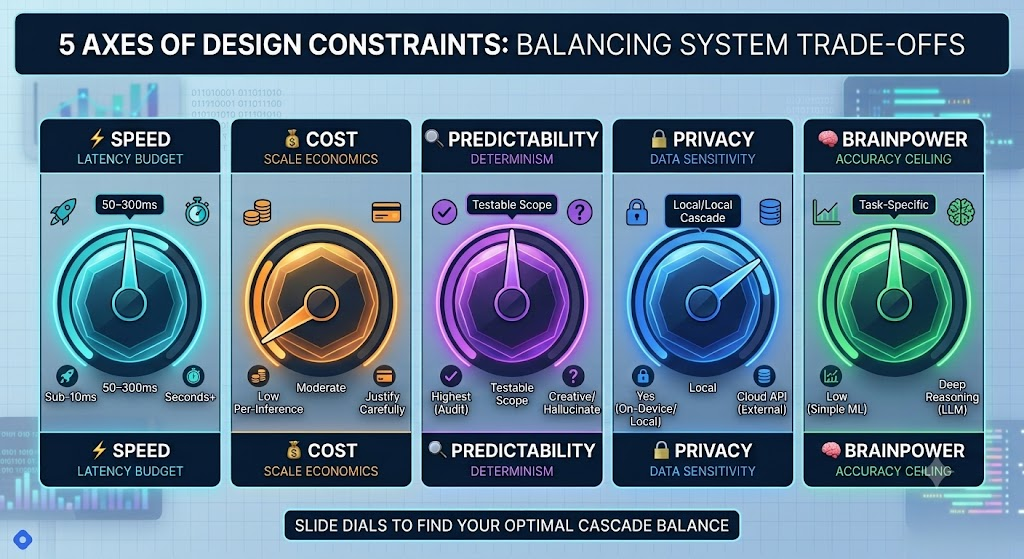
Before you build anything, you need to look at your problem through five basic lenses. Think of these as your design constraints:
⚡ Latency Budget (Speed): Does your user need an answer in milliseconds (like a search autofill), or are they okay waiting a few seconds (like generating a long report)?
💰 Cost at Scale (The Bill): What happens to your bank account when millions of people start using this system every single day?
🔍 Determinism (Predictability): Do you need the exact same, auditable answer every single time (like calculating taxes), or do you want creative variety?
🔒 Data Sensitivity (Privacy): Can this data securely leave your servers through a cloud API, or does it absolutely have to stay locked down locally on a phone or laptop?
🧠 Accuracy Ceiling (Brainpower): How much deep, complex reasoning does the task actually require?
🧱 The Blueprint: Designing an AI Team (The Tiers)
Instead of routing every single request to a giant, expensive AI, smart systems use an event-driven team approach. They pass the work down the line, only escalating to the bigger brains when absolutely necessary.
Here is how a real production setup handles a task:
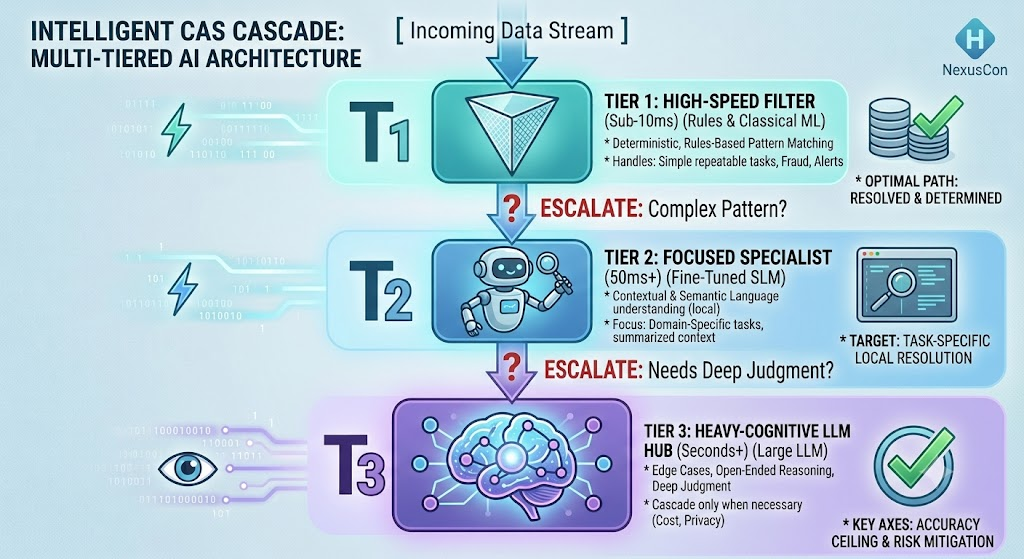
🧠 Tier 1: The Fast Filter (The Boundary Guard)
What it is: Basic code rules or traditional, math-based Machine Learning.
Why it's great: It is lightning fast (under 10 milliseconds) and highly predictable.
When to use it: If you are sorting data, checking for fraud, or filtering out obvious spam, handle it here. Don't waste an AI's time on things math can solve instantly.
🤖 Tier 2: The Focused Specialist (Small Language Models)
What it is: Smaller, lightweight language models (usually 1B to 8B parameters) that can run cheaply on small servers or even directly on a phone.
Why it's great: They are fast, local, and incredibly cheap to customize.
When to use it: If you need a model to summarize text, answer specific customer service questions, or extract keywords, you should fine-tune small models heavily. Teach them to do one job perfectly.
🌌 Tier 3: The Heavy Thinker (Large Language Models)
What it is: The massive, state-of-the-art giant models.
Why it's great: They have incredible, creative, and deep reasoning capabilities.
When to use it: These should be your last resort, not your default. Route tasks here only when Tier 1 and Tier 2 get confused by complex, open-ended problems that genuinely require human-like judgment. Use them sparingly to keep your bills low.
🛠️ Two Coding Tricks to Make AI Behave
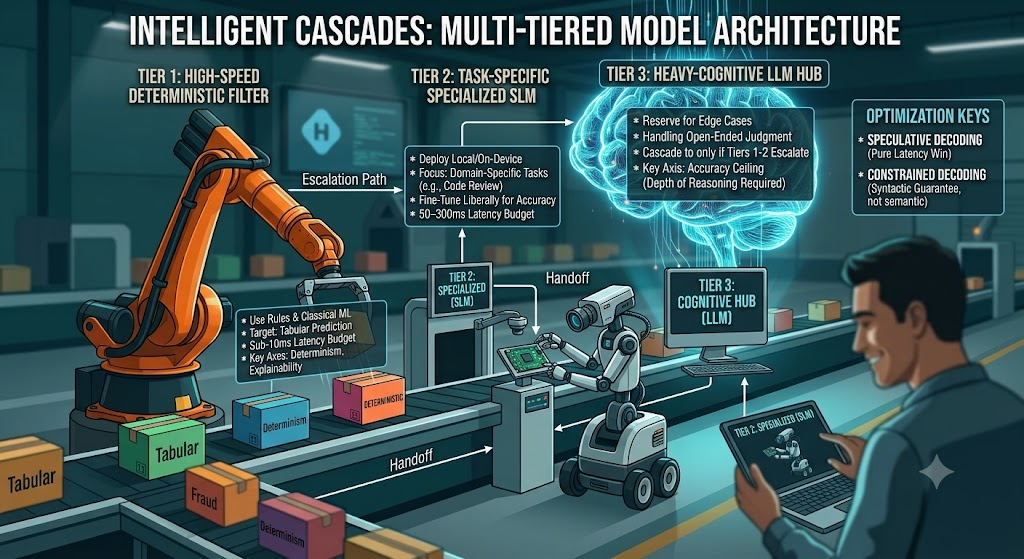
When you are connecting these different tiers together, things can get messy. Engineers use two clever tricks to make sure different models play nice:
🔮 Speculative Decoding: Imagine a fast assistant guessing the words to a sentence quickly, and a smart manager just nodding along or correcting it when it makes a mistake. That’s what this is. A small model drafts the text super cheaply, and the giant model approves it all at once. You get giant-model quality at small-model speeds.
🛡️ Constrained Decoding: Instead of asking an AI to give you data in a specific format (like a clean list) and hoping it does it right, you lock down its choices. You programmatically force the AI's settings so it physically cannot type an invalid character. It ensures your software integrations never break due to an AI "hallucination."
🛡️ How to Make Yourself "AI-Proof"
With smart workflows, automated code tools, and autonomous loops handling more execution tasks every day, a lot of builders wonder: Where do I fit in?
The answer comes down to understanding the difference between execution and intention.
AI is the ultimate execution engine. It can generate code blocks, format text, and process logs infinitely faster than us. But AI cannot figure out which problems are actually worth solving. It doesn't have a purpose.
To keep your skills completely irreplaceable, focus heavily on these three areas:
🎯 Intention: Setting the clear vision, goals, metrics, and ethical boundaries for what you are building.
🧩 Architecture: Knowing how to design the big picture—how different systems, databases, and code tiers react and talk to each other cleanly.
💡 Attention: Looking closely at real-world systems to find hidden bugs, friction points, and human needs that a machine metric will completely miss.
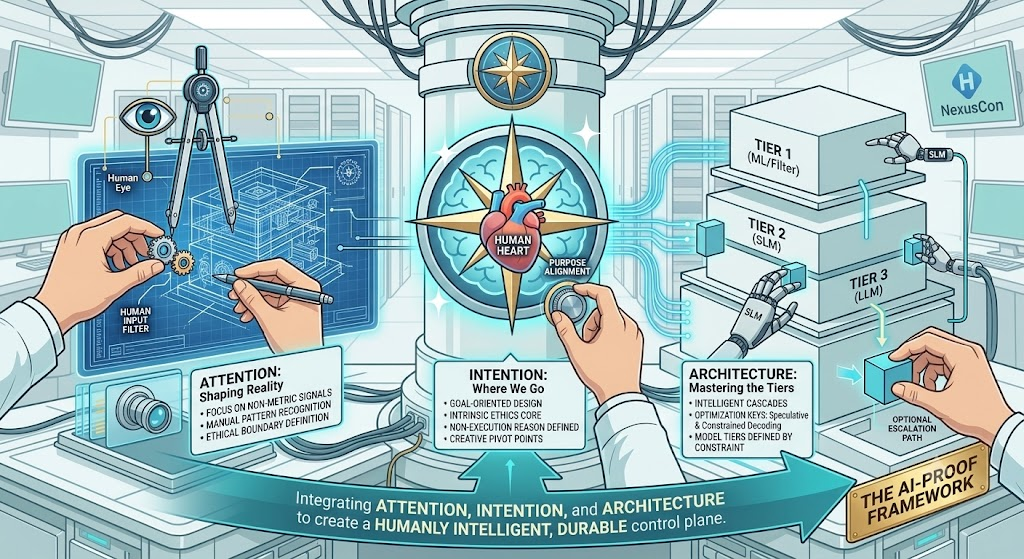
The future doesn’t belong to people who just write raw code rows by hand; it belongs to the tech architects who know how to design elegant, human-guided systems.
About the author
- I’m an engineer who enjoys turning messy engineering problems into simple, practical solutions. My work sits across AI automation, DevOps, SRE, cloud infrastructure, and developer experience. I like understanding why something is painful, finding ways to make it better, and building tools or workflows that reduce repetitive work and improve how developers operate. I write about the problems I encounter, the things I build, what I learn, and the ideas shaping modern engineering - from AI-assisted development and agentic systems to cloud automation, reliability, and developer tooling. I’m especially interested in the space where engineering, automation, and people meet - building useful technology and communicating it clearly.
Comments
Join the discussionNo comments yet. Be the first to comment.